


















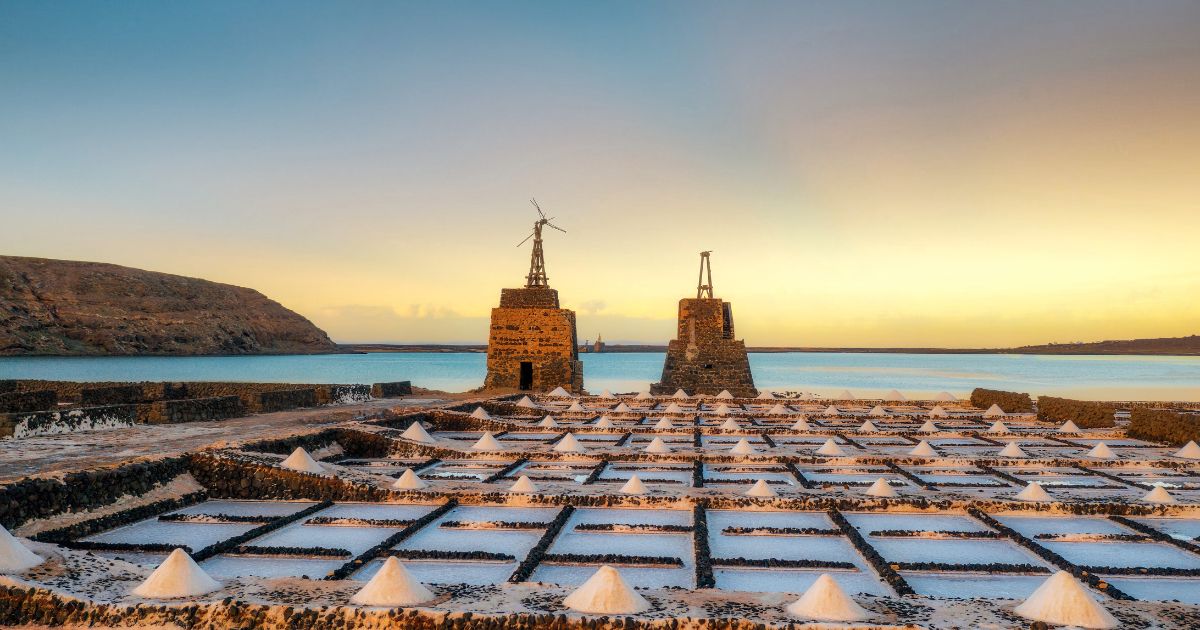
Lanzarote’s salt-works are beautiful and still productive, the legacy of an ancient industry that continues to the present day.
The vineyards of Lanzarote are world-famous, a unique landscape of thousands of pits protected by horseshoe-shaped stone walls, each containing a single vine. This result of the ingenuity of the islanders has won international design awards and featured in magazines such as National Geographic.
But the vineyards are not the only example of an incredible landscape that Lanzarote islanders pioneered by working hand-in-hand with nature. The island’s salt works are even older, just as innovative and equally eye-catching.
The oldest salinas on the island can be seen from the Mirador del Río and were built in 1520. In 1764, the Scottish traveller George Glas wrote:
“That part of Lanzarote facing the harbour of El Río, is an exceeding high and steep cliff, from the bottom of which to the harbour or seashore, is about two musket shot distance. The ground in this space is low, and here is a salina or salt-work, being a square space of land, levelled and divided by shallow trenches about two inches deep; into these they let the sea water, which, by the heat of the sun and the nature of the soil, soon turns into salt.”
Salt was important for preserving food and became an important export for Lanzarote, making the industry more profitable. It was this that prompted Lanzarote’s pioneering use of wind power to increase output.
This occurred at the Salinas de Janubio, built towards the end of the 19th century. The sea water for this salt works arrives during occasional high tides, when it fills the lagoon on the other side of the black sand ridge that forms the Janubio beach. But the water must then be moved again, and windmills were used to do the job.
Water is first kept in shallow pools where it is allowed to evaporate in the sun until it reaches a concentration of around 26% salinity. It is then pumped to other pools where crystallization takes place, finally resulting in pure salt that is shovelled into large, conical snow-white mounds.
During this process, conditions are perfect for living creatures that like high salinity. The vivid pink colour of some of the pools is caused by tiny crustaceans that live in the pools (these are also responsible for the colour of flamingos – a bird that is naturally white). A type of seaweed is responsible for reddish or ochre hues.
Lanzarote’s wind-powered salt-works were a pioneering idea, which was quickly adopted on other islands and further afield. For a while, the expertise of Lanzarote salt-workers was highly sought after.
At the industry’s high point there were 26 salinas on Lanzarote. The remains of some can still be seen, for example overlooking Arrecife’s Puerto Naos or near the power station. Others, such as the ones at Matagorda and what is now Costa Teguise, have long been overbuilt and survive only in the names of hotels or other buildings.
Two salinas still produce salt. Los Cocoteros near Guatiza reopened several years ago and produces gourmet salts, but it is Los Janubios that is responsible for most of the sea salt on CARPETS OF SALT Lanzarote and the Canaries, producing around 75% of the Canarian yield.