Among César Manrique’s most popular works are the series of fish he created in the mid-80s, a project that reflected a lifelong fascination with the marine world.
Fish have a special place in Canarian art. They are a recurrent motif in the works of the great Canarian symbolist, Nestor de la Torre, who in turn inspired Salvador Dalí. And they also fascinated Manrique.
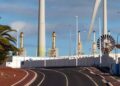
In Puerto del Carmen, his restored “wind toy” Robálo depicts dozens of sea bass, formed from triangular pieces of metal painted in bright primary colours. The gyrating sculpture represents the constant, unified motion of a shoal of fish, and shows how Manrique was inspired by the movement of wind and water throughout his career.
Fish inspired Manrique from the start. He was born and grew up near the Charco in Arrecife, the heart of the fishing barrio of Valterra. Remembering his long childhood summers at Famara, Manrique wrote “Always before my eyes were salty water, sand, rockpools with blennies, boats in dry dock supported by poles, boats coming and going under sail, being rowed…”.
But Manrique was always an artist first. When we interviewed his brother Carlos Manrique a few years ago, the old man told us of how, in their childhood, their father had given them two rods to go fishing with. Carlos set off to fish, but when he looked back his older brother was using his rod to draw in the sand.
An early sketch from 1945 finds Manrique depicting the unmistakable bright colours of a parrotfish (known locally as the vieja), and an untitled painting from the early 50s also shows two, already abstracted viejas lying next to a fishing boat. He described them later: “Viejas with red, brown and blue markings that fascinated my infant eyes like a wonderful toy.”
These influences inspired one of his most popular series of art, the Fauna Atlántica of 1985/86. In these works, he created several different fish. The originals appear to be untitled, but many have acquired names, since the fish they represent are recognisable. These include the Hammerhead Shark, the Flying Fish, the Puffer Fish and the Sole.
The fish are not realistic. They are described as “abstractions”, and each one is a jumble of eyes, teeth, scales, and fins, all depicted with bold blocks of colour. Manrique had been painting fossilized animals buried in volcanic lava or sand for several years since 1973 – for example, “Trapped in the Sand (“Charred Insect”) of 1975, which sold for €27,000 in 2018 shows a fly; another jumble of wings, eyes and legs, trapped in the sandy, volcanic soil of Lanzarote.
But in the Fauna Atlántica series, these flattened, crushed creatures are not contained by any frame, nor crushed by any element. They exist independently, engaging, strange and unique creatures.
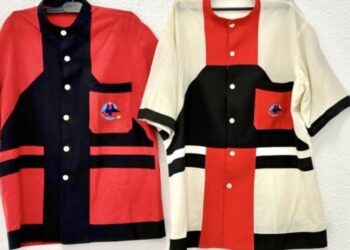
The fish are Manrique at his most playful and joyous, equally popular with adults and children. One of the most popular books sold by the César Manrique Foundation’s shops is the colouring book in which you can paint the fish in whichever colours you like. The fish have also appeared on jigsaws, mugs, T-shirts, and a designer-wear collection by Robert Verino.
Once you’ve noticed the fish, you’ll start seeing them everywhere. One wooden depiction, still perched on top of an abandoned fish-canning factory, overlooks the road into Arrecife from the Castillo de San José. The walls of the playgrounds of the Nieves Toledo primary school in the fishing barrio of Valterra are decorated with bright murals of the fish, and mosaictiled versions can also be found in and around the Real Club Náutico – Arrecife’s seafront sailing club.
The Suite Hotel Fariones has three of the original sculptures, large works that Manrique has created from various found materials. Meanwhile, in Tenerife’s capital, Santa Cruz, a large mural of the Flying Fish overlooks a children’s playground in the town centre. However, instead of the bright colours of the original, Manrique has chosen the warm terracotta, cream and brown colours that can be seen in the architecture of Tenerife.